How far is Agra from Delhi, and which route is fastest?
Agra is about 210 km from Delhi by the Yamuna Expressway, a drive of roughly 3 hours 15 minutes. There are two main roads plus a combined heritage route, and your driver picks the best one for the day's traffic and the stops you want to make.
| Route | Via | Distance | Travel time | Best for |
|---|---|---|---|---|
| Route 1 (recommended) | DND Flyway → Yamuna Expressway → Agra | ~210 km | 3 hr 15 min | Fastest, smoothest highway, minimal traffic |
| Route 2 (NH-19) | Old Mathura Road → Faridabad → Palwal → Mathura → Agra | ~235 km | 4 hr 30 min | Local stops, dhabas, more scenic |
| Route 3 (heritage circuit) | Yamuna Expressway → Mathura → Vrindavan → Agra | ~240 km | 4 hr 45 min | Krishna darshan plus the Taj Mahal |
The Yamuna Expressway, also called the Taj Expressway, is a 6-lane, access-controlled toll road with smooth tarmac and well-spaced rest areas that have clean restrooms and food courts. Our drivers know where to stop and how to time the start so you miss the Mahipalpur and Faridabad bottlenecks.
What are the top places to visit in Agra?
Agra has three UNESCO World Heritage Sites — the Taj Mahal, Agra Fort and Fatehpur Sikri — plus several quieter Mughal monuments that are easy to add when the cab is at your disposal.
Taj Mahal
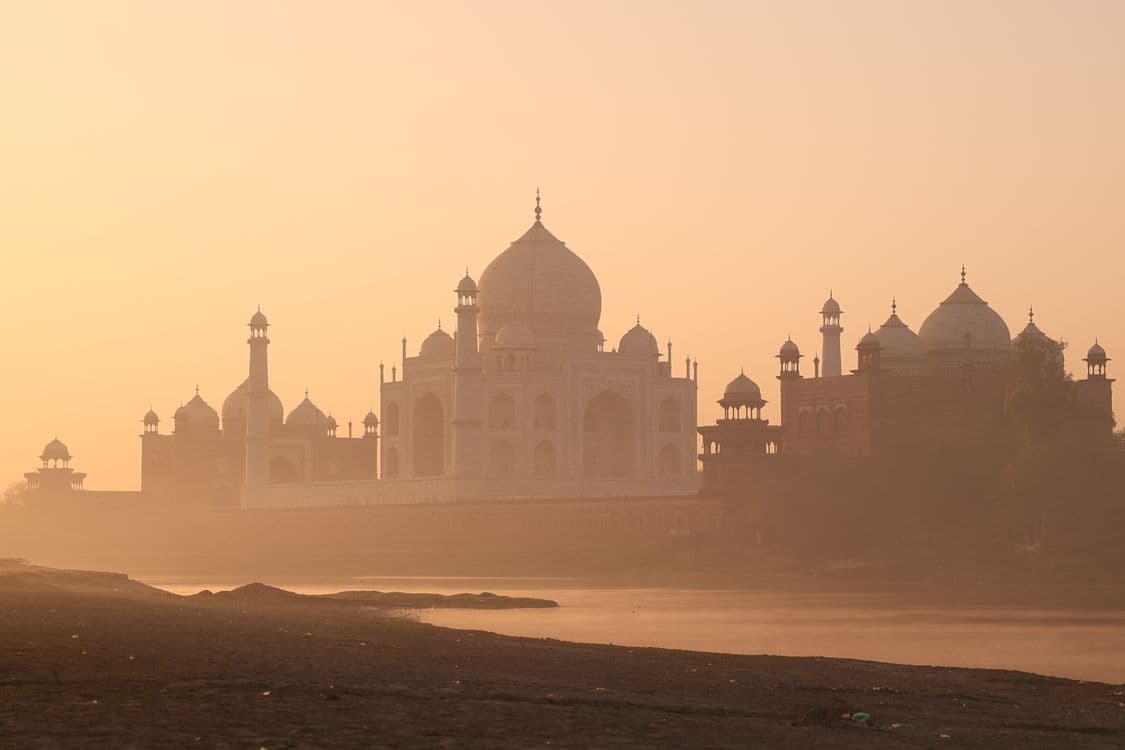
Shah Jahan built the Taj between 1632 and 1653 as a mausoleum for his wife Mumtaz Mahal. It is made of white Makrana marble inlaid with semi-precious stones (pietra dura), and its colour shifts through the day — rosy at dawn, milky white at noon and golden at sunset. It is open from sunrise to sunset and closed on Fridays. Sunrise brings the best light, the thinnest crowds and the coolest air.
Agra Fort
Akbar began this red sandstone fort in 1565 and Shah Jahan expanded it; it was the main royal residence of the Mughals until 1638. Look for the Diwan-i-Aam, the Diwan-i-Khas, the Sheesh Mahal (Palace of Mirrors) and the Musamman Burj, where Aurangzeb imprisoned his father Shah Jahan within sight of the Taj.
Fatehpur Sikri
About 40 km from Agra, Akbar's red sandstone capital was built in 1571 and abandoned just 14 years later because of a water shortage. Highlights include the Buland Darwaza, one of the tallest gateways in the world, the Jama Masjid, the tomb of the Sufi saint Sheikh Salim Chishti and the Panch Mahal.
Itimad-ud-Daulah, the "Baby Taj"
Empress Nur Jahan built this white marble tomb for her father, Mirza Ghiyas Beg, between 1622 and 1628. Many historians see it as the prototype for the Taj, because the inlay technique was perfected here first. Expect peaceful gardens, Yamuna views and far smaller crowds.
Mehtab Bagh
This Mughal-era garden lies directly across the Yamuna from the Taj Mahal and is the classic spot for a sunset photograph, with very few people around.
Sikandra (Akbar's Tomb)
Just 13 km from Agra on the Delhi–Agra highway, Akbar's tomb (1605–1613) blends Hindu, Muslim, Buddhist, Jain and Christian motifs, reflecting his idea of Din-i Ilahi.
Jama Masjid, Sadar Bazaar and Kinari Bazaar
Jahanara, Shah Jahan's daughter, built the Jama Masjid in 1648; it is one of the largest mosques in India. The bazaars nearby are the place for marble inlay souvenirs, leather goods and Agra's famous petha.
Chini Ka Rauza and Ram Bagh
With a full day to spare, add Chini Ka Rauza, the tile-decorated tomb of Shah Jahan's prime minister Afzal Khan, and Ram Bagh, the oldest Mughal garden in India, laid out by Babur in 1528.
Delhi to Agra Taj Mahal cab: can you see Agra in a day?
Yes. This tested same-day itinerary covers Sikandra, the Taj Mahal and Agra Fort:
- 5:30 AM — pickup from your Delhi address
- 5:45 AM — onto the Yamuna Expressway, with breakfast at a clean rest area
- 9:00 AM — short visit to Sikandra
- 10:00 AM — drive to the Taj, park at Shilpgram and take an e-rickshaw to the West Gate
- 10:30 AM – 1:00 PM — Taj Mahal visit and photographs
- 1:00 PM — lunch at a recommended local restaurant
- 2:30 PM — Agra Fort (about 2 hours)
- 4:30 PM — Sadar Bazaar for petha and marble souvenirs
- 5:30 PM — start back via the Yamuna Expressway
- 9:00 PM — home in Delhi
Allow 15–16 hours including driving. With an extra day you can add Mathura and Vrindavan before Agra, or continue to Jaipur on a 3-day Golden Triangle trip.
When is the best time to visit Agra?
October to March is the best season, with temperatures of roughly 10–28°C that suit a long day on your feet. Avoid May and June, when the mercury crosses 45°C and walking on the marble becomes extremely uncomfortable. The July–September monsoon is pleasant, with occasional showers.
- Fridays: the Taj Mahal is closed to general visitors, so never plan a one-day Agra trip on a Friday.
- Full-moon nights: the Taj opens for night viewing on five nights around each full moon, except during Ramzan. Tickets must be booked at the ASI office at least 24 hours ahead — ask us about a night-viewing cab.
Travel tips for a Delhi to Agra one way taxi or round trip
- Start early. A 5:30 AM departure beats Delhi traffic and gets you to the Taj before the crowds.
- Carry original photo ID. Aadhaar, passport, voter ID or driving licence is mandatory for Taj entry.
- Buy Taj tickets online on the ASI website to skip the queue. At the time of writing they cost ₹50 for Indian citizens and ₹1,100 for foreigners, plus ₹200 to enter the main mausoleum.
- Wear slip-on shoes. You take them off at the Taj and walk on marble that gets hot in the sun.
- Travel light. Only water, a small camera and a phone are allowed inside; larger bags and food go to the cloak room.
- Use licensed guides only. Government-licensed guides at the Taj charge fixed rates; ignore touts.
- Eat local: petha from Panchhi Petha or Gopaldas, bedhai and jalebi for breakfast, and Mughlai curries and kebabs at Pinch of Spice.
- Keep some cash for entry, parking and e-rickshaws to the Taj gate — many small vendors near the monuments do not take UPI.