How far is Vrindavan from Delhi, and which route is quickest?
Vrindavan is roughly 152 km from Delhi. On the recommended route — the DND Flyway onto the Yamuna Expressway, past Mathura — the drive takes about 2 hours 30 minutes. We choose between three routes depending on traffic and where in Delhi NCR you start.
| Route | Via | Distance | Travel time | Best for |
|---|---|---|---|---|
| Route 1 (recommended) | DND Flyway → Yamuna Expressway → Mathura → Vrindavan | ~152 km | 2 hr 30 min | Fastest and smoothest highway |
| Route 2 | NH-19 (Old Mathura Road) → Faridabad → Palwal → Kosi → Vrindavan | ~165 km | 3 hr 30 min | Slower, more local stops |
| Route 3 (via Mathura) | Yamuna Expressway → Mathura sightseeing → Vrindavan | ~165 km | 3 hr 15 min | Combined Mathura and Vrindavan yatra |
The Yamuna Expressway is a 6-lane, access-controlled road with light traffic, clean rest stops and good food courts at several toll plazas, which is why most of our Vrindavan trips use it. Mathura is only 12 km from Vrindavan, so many families visit both; if Mathura is your main stop, see our Delhi to Mathura taxi page.
Which temples should you visit in Vrindavan?
Vrindavan has more than 5,000 temples dedicated to Krishna and Radha. Tell your driver which ones matter most to you and he will plan an easy temple-hopping circuit.
Banke Bihari Temple
The most famous temple in Vrindavan sits in the heart of the old town and is dedicated to Krishna in his child form. The curtain in front of the deity is drawn every few seconds — devotees believe that holding Bihariji's gaze too long could make Him leave the temple and follow you home. Go for the early-morning darshan around 8 AM or the evening aarti, and avoid weekends and festival days if you want it quieter.
ISKCON Vrindavan (Sri Krishna Balaram Mandir)
Built by Srila Prabhupada in 1975, this marble temple has three altars — Krishna-Balaram, Radha-Shyamsundar and Gaur-Nitai — along with a guesthouse, Govinda's restaurant and Prabhupada's samadhi. The evening Sandhya Aarti with kirtan is a moving experience.
Prem Mandir
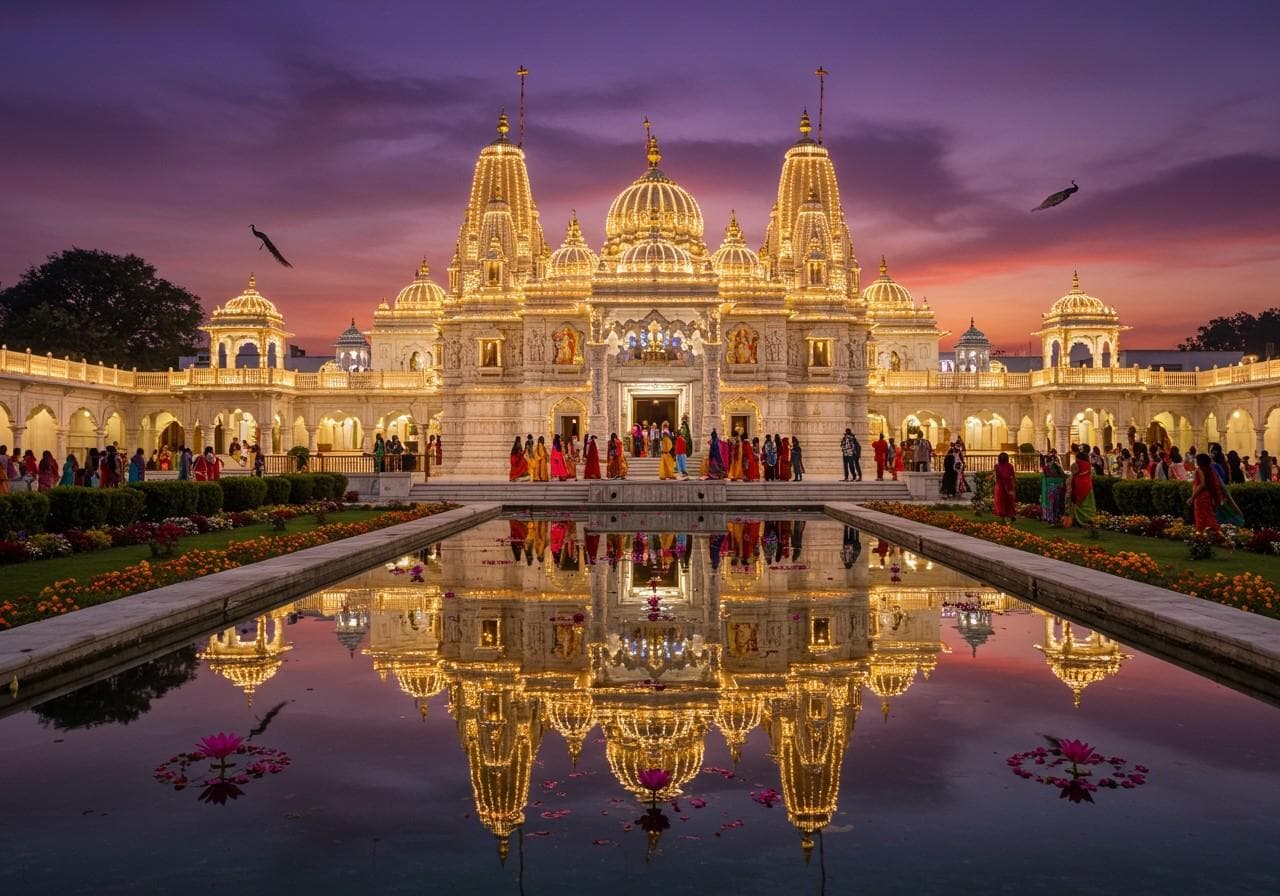
Jagadguru Shri Kripaluji Maharaj built this white marble temple across a 54-acre complex in 2012. Life-size scenes show Krishna lifting Govardhan Hill, the rasa-leela and the taming of Kaliya Naag. Stay for the musical fountain show in the evening.
Radha Raman Temple
One of the seven historical temples of Vrindavan, it houses a self-manifested deity of Krishna, and its kitchen has cooked the deity's bhog on firewood in an unbroken 500-year tradition. The Rajasthani-style temple is peaceful and wheelchair accessible.
Nidhivan
Local lore says Krishna performs the rasa-leela here with Radha and the gopis every night. The grove's trees are short and gnarled with intertwined branches, and it is sealed after sunset — even the priests leave food and water and lock the doors behind them.
Govind Dev Temple
Raja Man Singh of Amber built this 16th-century red sandstone temple under Emperor Akbar's patronage. Its blend of Hindu, Mughal and European styles makes it one of the most historically significant temples in North India.
Keshi Ghat and the Yamuna Aarti
This is the loveliest ghat on the Yamuna in Vrindavan. Come at sunset for the Yamuna Aarti, when lit diyas float on the river; boat rides run during the day.
Pagal Baba, Shahji and Rangji temples
With a full day in town, ask your driver to add these lesser-known but striking temples, each with its own story.
Which Vrindavan festivals need early booking?
- Janmashtami (August–September): Krishna's birthday, with all-night kirtans, jhulan and special darshans. Book your cab 2–3 weeks ahead.
- Holi (March): world-famous, with Phoolon ki Holi at Banke Bihari and Lathmar Holi at nearby Barsana. Crowds are massive, so pre-booking is essential.
- Radhashtami (September): Radha's birthday, celebrated across all the major temples.
- Govardhan Puja (November): the day after Diwali, when devotees walk the parikrama of Govardhan Hill.
- Akshaya Tritiya (April–May): the only day of the year when devotees can see the charan (feet) of Banke Bihari.
When is the best time to visit Vrindavan?
Plan your trip between October and March, when days are mild — roughly 12–28°C — and ideal for walking between temples. April to June is very hot, often above 42°C, so an air-conditioned cab makes a real difference. If you can, travel on a weekday: Sundays and festival weekends bring the biggest queues.
Travel tips for a smooth Vrindavan trip
- Dress modestly and cover shoulders and knees — Banke Bihari is especially strict.
- Leave phones and cameras in the cab. They are not allowed inside Banke Bihari.
- Wear comfortable footwear for the narrow, crowded lanes of the old town.
- Carry small change for offerings, prasad and rickshaws — cars cannot enter the narrow lanes.
- Time your darshan for 8–10 AM or 6–7 PM; most temples close from about 12 to 4 PM.
- Stay hydrated, especially if you plan a parikrama in summer.
- Need step-free access? Radha Raman, ISKCON and Prem Mandir have ramps and wheelchair access. Banke Bihari's lanes are narrow, but your driver can help arrange a wheelchair-friendly drop point.
- Try the local food: peda from Brijwasi, kachori-sabzi, lassi and the kheer at Govinda's in ISKCON.
Want to see the Taj on the same trip? Vrindavan pairs naturally with a Delhi to Agra taxi itinerary.